ASQ 9 Months Screening: Key Milestones, Questions, and How to Calculate the Correct Interval
Nine months is a busy age. Your baby may be crawling, babbling with real intent, or banging two toys together just to see what happens. It is also the age at which the American Academy of Pediatrics recommends a formal developmental screening, and many clinics use the 9-month ASQ-3 for exactly that purpose. If a …
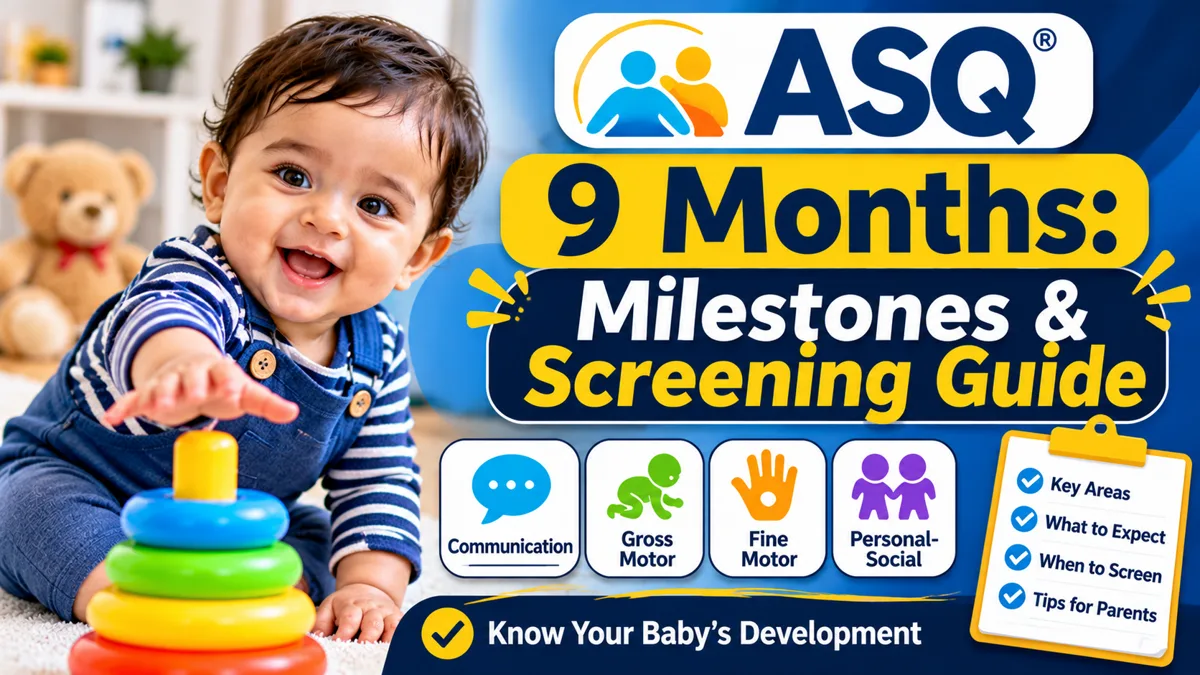
Nine months is a busy age. Your baby may be crawling, babbling with real intent, or banging two toys together just to see what happens. It is also the age at which the American Academy of Pediatrics recommends a formal developmental screening, and many clinics use the 9-month ASQ-3 for exactly that purpose.
If a form has just landed in your inbox or been handed over at a well-child visit, this guide explains what to expect.
Why screen at 9 months?
The AAP recommends structured developmental screening at 9, 18 and 30 months, with autism-specific screening at 18 and 24 months. The 9-month visit is the first of these. Catching a possible concern early opens the door to support while the brain is most responsive to it.
Screening is not a test your baby can pass or fail. Think of it as a structured conversation that turns what you see every day into something your care team can compare with typical development.
Is the 9-month ASQ the right form for your baby?
The 9-month ASQ-3 is meant for babies aged 8 months 0 days through 9 months 30 days. If your child falls in that range, this is the questionnaire to use. If they were born three or more weeks early, use their corrected age instead.
Not sure? Use our tool to calculate the 9-month ASQ score and interval with your child’s birth date.
What the 9-month questionnaire covers
The questionnaire asks about five developmental areas, each with six items. Parents answer yes, sometimes or not yet. We cannot reproduce the official questions because they are copyrighted, but here is the kind of skill each area looks at:
- Communication: responding to their name, making different babble sounds, understanding simple words or gestures.
- Gross motor: sitting without support, moving into a sitting position, bearing weight on legs, crawling or scooting.
- Fine motor: picking up small objects with fingers, passing a toy between hands, using a pincer-style grasp.
- Problem solving: looking for a hidden toy, exploring objects, copying simple actions.
- Personal-social: playing peekaboo, showing interest in other people, reaching to be picked up.
A yes scores 10 points, sometimes scores 5 and not yet scores 0, so each area totals out of 60. There is also an overall section for general concerns, which is just as important as the numbers.
9-month ASQ-3 cutoff scores
The cutoff is the score below which a child is flagged for further assessment. The published 9-month cutoffs are approximately:
| Area | Cutoff |
|---|---|
| Communication | 13.97 |
| Gross motor | 17.82 |
| Fine motor | 31.32 |
| Problem solving | 28.72 |
| Personal-social | 18.91 |
A score above the cutoff is in the typical range. A score in the grey (monitoring) zone, a little above the cutoff, calls for activities and re-screening. A score below the cutoff suggests talking to your pediatrician about further evaluation. Always check these values against the official ASQ-3 scoring sheet your provider uses. Our full explanation is in the ASQ-3 cutoff scores guide.
Tips for filling it in accurately
- Try each activity with your baby instead of answering from memory.
- Pick a calm moment. A hungry or sleepy baby will not show their best skills.
- Answer for today, not for what you hope. A truthful not yet is more useful than an optimistic yes.
- Do not worry about the odd not yet. Every baby has a few.
- Share what concerns you in the overall section, even if scores look fine.
What happens after the questionnaire?
Your provider adds up the scores for each area and compares them with the cutoffs. If everything is typical, you continue regular check-ups. If one area falls in the grey zone, you might get activity ideas and be asked to re-screen in a few months. If a score is below the cutoff, the next step is usually a conversation about a more detailed assessment or referral to early intervention. That is support, not a verdict.
Frequently asked questions
What age is the ASQ 9 month questionnaire for?
Babies from 8 months 0 days to 9 months 30 days.
Is ASQ-3 screening the same as a diagnosis?
No. It highlights children who may benefit from a closer look.
My baby was premature. Which form do I use?
Use the corrected age if your baby was born three or more weeks early and is under 24 months.
What if my baby cannot do something yet?
Mark not yet. Skills develop at different speeds, and the score only matters in context.
General information only; it does not replace advice from your pediatrician.